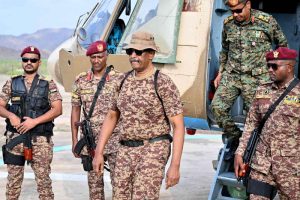
The United States has designated the Sudanese Muslim Brotherhood as a “specially designated global terrorist” organisation, a move that could reshape the dynamics of Sudan’s brutal civil war and deepen the country’s diplomatic isolation. The decision, announced by US Secretary of State Marco Rubio, signals Washington’s growing concern over the role of Islamist networks and foreign actors in Sudan’s conflict.
In a statement issued on March 9, 2026, Rubio said the group has used “unrestrained violence against civilians to undermine efforts to resolve the conflict in Sudan and advance its violent Islamist ideology.” The designation allows the United States to impose financial sanctions and block assets linked to the organisation. Washington also said it intends to classify the group as a “foreign terrorist organisation” next week, which would criminalise providing material support to it.
The decision comes as Sudan remains engulfed in a devastating war between the Sudanese Armed Forces led by Abdel Fattah al-Burhan and the paramilitary Rapid Support Forces commanded by Mohamed Hamdan Dagalo. The conflict, which began in April 2023, has killed thousands and displaced millions of people, threatening the country’s humanitarian situation.
Allegations of Iranian support
According to the US State Department, the Sudanese Muslim Brotherhood has received training and backing from the Islamic Revolutionary Guard Corps. American officials argue that the alleged ties highlight the growing involvement of external actors in Sudan’s war.
Washington also accused the group of carrying out mass executions and attacks against civilians during the conflict. Human rights organisations have repeatedly warned that atrocities committed by multiple armed factions have contributed to what the United Nations describes as one of the world’s worst humanitarian crises.
The designation may create additional diplomatic pressure on Burhan’s military leadership. Critics of the Sudanese army argue that Islamist networks linked to the former regime of Omar al-Bashir have regained influence within military-aligned structures during the war.
If elements associated with the Sudanese Muslim Brotherhood are indeed operating alongside army forces, the US designation could complicate the military government’s international standing and restrict potential financial channels or political engagement.
Regional reactions and geopolitical context
The United Arab Emirates welcomed Washington’s decision, saying it reflects efforts to curb violence and destabilising activities linked to the Brotherhood network in Sudan. Gulf states have closely monitored the conflict, which carries implications for Red Sea security and regional power competition.
Analysts say the designation also intersects with broader geopolitical rivalries across the Horn of Africa and the Middle East. Sudan’s location between North Africa, the Sahel and the Red Sea corridor makes its instability a concern for neighbouring states including Ethiopia and Eritrea, as well as Gulf powers with strategic interests along the maritime route.
With Sudan already fragmented by armed factions, economic collapse and international isolation, Washington’s move adds another layer of complexity to an already volatile conflict. Whether [the] designation alters the balance of power on the ground or pushes political actors toward negotiations remains uncertain, but it underscores the widening international dimension of Sudan’s war.